

Iconoclasm
Kolbe Report 3/15/25

Dear Friends of the Kolbe Center,
Glory to Jesus Christ!
We have often observed in our newsletters that a belief in evolution fosters contempt for Tradition and for the study of history so that the lessons that could be learned from our forefathers to solve current problems are often overlooked. In Byzantine Catholic Churches throughout the world, last Sunday, the first Sunday in Lent, was celebrated as the Sunday of Orthodoxy, when the faithful recall the triumph of the Orthodox Catholic Faith over the heresy of iconoclasm, a heresy which dominated most of the Catholic world for more than a hundred years before the final triumph of the true Catholic teaching on the holy icons, faithfully championed by the successors of St. Peter.
In this newsletter, we will briefly recall the history of the iconoclast movement as summarized by the 1913 Catholic Encyclopedia. The article explains that while the iconoclast movement was launched by the Byzantine Emperor Leo the Isaurian, its success was not only achieved through the use of political and military force against the orthodox. Iconoclasm ultimately held sway for as long as it did because it presented itself as a reform movement, allegedly purifying the Faith of errors and irrational elements. It was this use of political and military force exercised in the name of reason and reform that made iconoclasm such a threat to Church unity and orthodoxy. By recalling this important chapter in our history, we can understand the similarity between the iconoclasm of the first millennium, the iconoclasm of the Protestant Revolution, and the even deadlier form of iconoclasm in our day that has resulted in the modernist takeover of most of our institutions and the worst persecution of orthodoxy in the history of the Church. By understanding the present crisis of faith in the light of the past, by the grace of God we can see the solution to the crisis and the key to the restoration of orthodoxy and unity in the Church throughout the world.
The Rise and Fall of Iconoclasm
As the Catholic Encyclopedia explains, the Iconoclast heresy was imposed from above, beginning with the Byzantine Emperor, Leo III, known also as Leo the Isaurian:
Leo the Isaurian was a valiant soldier with an autocratic temper. . . The Khalifa Omar II (717-20) tried to convert him [to Islam], without success except as far as persuading him that pictures are idols. The Christian enemies of images, notably Constantine of Nacolia, then easily gained his ear. The emperor came to the conclusion that images were the chief hindrance to the conversion of Jews and Moslems, the cause of superstition, weakness, and division in his empire, and opposed to the First Commandment. The campaign against images as part of a general reformation of the Church and State. Leo III's idea was to purify the Church, centralize it as much as possible under the Patriarch of Constantinople, and thereby strengthen and centralize the State of the empire. There was also a strong rationalistic tendency among there Iconoclast emperors, a reaction against the forms of Byzantine piety that became more pronounced each century. This rationalism helps to explain their hatred of monks. Once persuaded, Leo began to enforce his idea ruthlessly. . . In 726 Leo III published an edict declaring images to be idols, forbidden by Exodus 20:4-5, and commanding all such images in churches to be destroyed. At once the soldiers began to carry out his orders, whereby disturbances were provoked throughout the empire. There was a famous picture of Christ, called Christos antiphonetes, over the gate of the palace at Constantinople. The destruction of this picture provoked a serious riot among the people. Germanus, the patriarch, protested against the edict and appealed to the pope (729). But the emperor deposed him as a traitor (730) and had Anastasius (730-54), formerly syncellus of the patriarchal Court, and a willing instrument of the Government, appointed in his place. The most steadfast opponents of the Iconoclasts throughout this story were the monks. It is true that there were some who took the side of the emperor but as a body Eastern monasticism was steadfastly loyal to the old custom of the Church. Leo therefore joined with his Iconoclasm a fierce persecution of monasteries and eventually tried to suppress monasticism altogether.
The pope at that time was Gregory II (713-31). Even before he had received the appeal of Germanus a letter came from the emperor commanding him to accept the edict, destroy images at Rome, and summon a general council to forbid their use. Gregory answered, in 727, by a long defence of the pictures. He explains the difference between them and idols, with some surprise that Leo does not already understand it. He describes the lawful use of, and reverence paid to, pictures by Christians. He blames the emperor's interference in ecclesiastical matters and his persecution of image-worshippers. A council is not wanted; all Leo has to do is to stop disturbing the peace of the Church. As for Leo's threat that he will come to Rome, break the statue of St. Peter (apparently the famous bronze statue in St. Peter's), and take the pope prisoner, Gregory answers it by pointing out that he can easily escape into the Campagna, and reminding the emperor how futile and now abhorrent to all Christians was Constans's persecution of Martin I. He also says that all people in the West detest the emperor's action and will never consent to destroy their images at his command (Greg. II, "Ep. I ad Leonem"). The emperor answered, continuing his argument by saying that no general council had yet said a word in favour of images that he himself is emperor and priest (basileus kai lereus) in one and therefore has the right to make decrees about such matters. Gregory writes back regretting that Leo does not yet see the error of his ways. As for the former general Councils, they did not pretend to discuss every point of the faith; it was unnecessary in those days to defend what no one attacked. The title Emperor and Priest had been conceded as a compliment to some sovereigns because of their zeal in defending the very faith that Leo now attacked. The pope declares himself determined to withstand the emperor's tyranny at any cost, though he has no defence but to pray that Christ will send a demon to torture the emperor's body that his soul be saved, according to 1 Corinthians 5:5 . . .
Pope Gregory II died in 731. He was succeeded at once by Gregory III, who carried on the defence of holy images in exactly the spirit of his predecessor. . . In 731 Gregory III held a synod of ninety-three bishops at St. Peter's in which all persons who broke, defiled, or took images of Christ, of His Mother, the Apostles or other saints were declared excommunicate. Another legate, Constantine, was sent with a copy of the decree and of its application to the emperor, but was again arrested and imprisoned in Sicily. Leo then sent a fleet to Italy to punish the pope; but it was wrecked and dispersed by a storm. Meanwhile every kind of calamity afflicted the empire; earthquakes, pestilence, and famine devastated the provinces while the Moslems continued their victorious career and conquered further territory.
Leo III died in June, 741, in the midst of these troubles, without having changed policy. . . Leo IV (775-80), although he did not repeal the Iconoclast law was much milder in enforcing them. He allowed the exiled monks to come back, tolerated at least the intercession of saints and tried to reconcile all parties. When the patriarch Nicetas I died in 780 he was succeeded by Paul IV (780-84), a Cypriote monk who carried on a half-hearted Iconoclast policy only through fear of the Government. But Leo IV's wife Irene was a steadfast image-worshipper. Even during her husband's life she concealed holy icons in her rooms. At the end of his reign Leo had a burst of fiercer Iconoclasm. He punished the courtiers who had replaced images in their apartments and was about to banish the empress when he died 8 September, 780. At once a complete reaction set in.
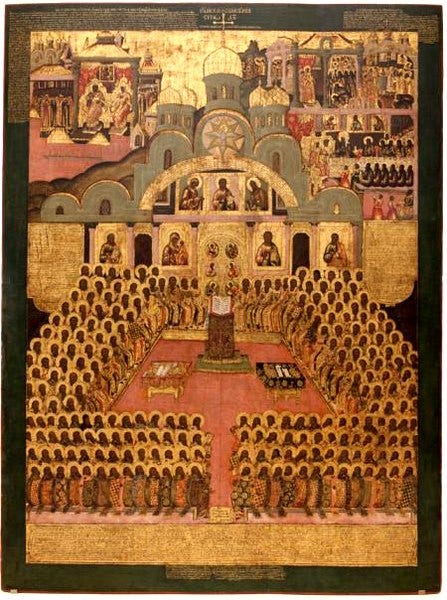
The Empress Irene was regent for her son Constantine VI (780-97), who was nine years old when his father died. She immediately set about undoing the work of the Iconoclast emperors. Pictures and relics were restored to the churches; monasteries were reopened. Fear of the army, now fanatically Iconoclast, kept her for a time from repealing the laws; but she only waited for an opportunity to do so and to restore the broken communion with Rome and the other patriarchates. The Patriarch of Constantinople, Paul IV, resigned and retired to a monastery, giving openly as his reason repentance for his former concessions to the Iconoclast Government. He was succeeded by a pronounced image-worshipper, Tarasius. Tarasius and the empress now opened negotiations with Rome. They sent an embassy to Pope Adrian I (772-95) acknowledging the primacy and begging him to come himself, or at least to send legates to a council that should undo the work of the Iconoclast synod of 754. The pope answered by two letters, one for the empress and one for the patriarch. In these he repeats the arguments for the worship of images agrees to the proposed council, insists on the authority of the Holy See, and demands the restitution of the property confiscated by Leo III. He blames the sudden elevation of Tarasius (who from being a layman had suddenly become patriarch), and rejects his title of Ecumenical Patriarch, but he praises his orthodoxy and zeal for the holy images. Finally, he commits all these matters to the judgment of his legates. These legates were an archpriest Peter and the abbot Peter of St. Saba near Rome. The other three patriarchs were unable to answer, they did not even receive Tarasius's letters, because of the disturbance at that time in the Moslem state. But two monks, Thomas, abbot of an Egyptian monastery and John Syncellus of Antioch, appeared with letters from their communities explaining the state of things and showing that the patriarchs had always remained faithful to the images. These two seem to have acted in some sort as legates for Alexandria, Antioch and Jerusalem.
Tarasius opened the synod in the church of the Apostles at Constantinople. in August, 786; but it was at once dispersed by the Iconoclast soldiers. The empress disbanded those troops and replaced them by others; it was arranged that the synod should meet at Nicaea in Bithynia, the place of the first general council. The bishops met here in the summer of 787, about 300 in number. The council lasted from 24 September to 23 October. The Roman legates were present; they signed the Acts first and always had the first place in the list of members, but Tarasius conducted the proceeding, apparently because the legates could not speak Greek. In the first three sessions Tarasius gave an account of the events that had led up to the Council, the papal and other letters were read out, and many repentant Iconoclast bishops were reconciled. The fathers accepted the pope's letters as true formulas of the Catholic Faith. . . An eighth and last session was held on 23 October at Constantinople in the presence of Irene and her son. After a discourse by Tarasius the Acts were read out and signed by all, including the empress and the emperor.
Between 814 and 842 there was a resurgence of iconoclasm within the Byzantine Empire which did not end until:
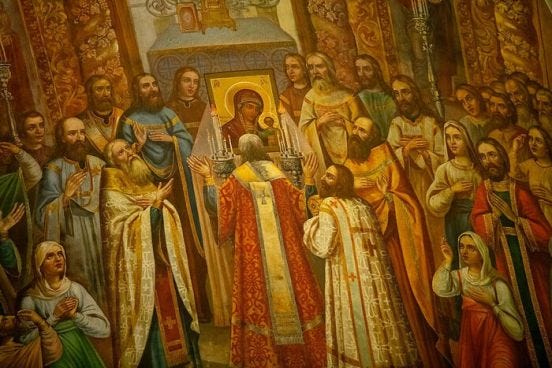
a synod at Constantinople . . . renewed the decree of the Second Council of Nicaea and excommunicated Iconoclasts . . . On the first Sunday of Lent (19 February, 842) the icons were brought back to the churches in solemn procession. That day (the first Sunday of Lent) was made into a perpetual memory of the triumph of orthodoxy at the end of the long Iconoclast persecution. It is the "Feast of Orthodoxy" of the Byzantine Church still kept very solemnly by both Uniates and Orthodox. Twenty years later the Great Schism began. So large has this, the last of the old heresies, loomed in the eyes of Eastern Christians that the Byzantine Church looks upon it as a kind of type of heresy [and] the Feast of Orthodoxy, founded to commemorate the defeat of Iconoclasm, has become a feast of the triumph of the Church over all heresies.
Protestantism, Modernism and the New Iconoclasm
The iconoclast movement was a kind of “type of heresy” because it rejected the orthodox faith and worship that had been handed down from the Apostles under the guise of reforming and purifying the Faith of errors. While the emperor and his minions in civil and ecclesial positions of power imposed their errors by force, they could not have succeeded if they had not at the same time been able to rationalize their actions as “reforms” and rational efforts to “purify” the Church of unreasonable novelties. The leaders of the Protestant Revolution wittingly or unwittingly followed this playbook and claimed that they were purging Christianity of novelties introduced by the Church of Rome by denying various “unreasonable” dogmas of the Faith, like transubstantiation, and by destroying the liturgical treasures of the Church which they alleged to be false additions to the “pure” Christianity of the apostolic age. Once again, it was the successors of St. Peter who held fast to the Tradition (and authentic traditions) that had been “handed down” from the Apostles, even as the Protestant heresiarchs looked to the kings of Northern Europe to play the part of Leo the Isaurian in imposing the “Reformed” Iconoclasm of Protestantism upon their subjects in another top-down persecution of the traditional Orthodox-Catholic Faith.
In recent times, a third assault on the traditional Catholic Faith and her Holy Icons has been unleashed, but this one is much worse than the previous two because it has been supported by the Vicar of Christ himself and by many of the Bishops in union with him. Once again, the modernist assault on the traditional Faith and Worship of the Church has been justified by intellectuals who argue that they are only seeking to “purify” the Church and restore Her to her “primitive” simplicity, while purging Her academic institutions of “irrational” and “unscientific” beliefs like special creation. Since before Vatican II, these “reformers” from within have argued that practices like communion in the hand and married clergy represent a return to the original practices of the apostolic age and that devotions like the Holy Rosary and True Devotion to Mary represent accretions to the primitive Christ-centered simplicity of the Faith which should be purged or down-played. As in the previous two assaults on Orthodox Catholic Faith and worship, however, this one is also being smashed to smithereens on the Rock of St. Peter, even as the Vicar of Christ himself tries to lead the assault in his own name. This is because while modernists in high positions love to use their authority to forcibly advance their agenda and to crush clergy and laity who uphold and defend the traditional faith and worship of the Church, they cannot change the fact that what their predecessors have previously “bound on earth” remains “bound in Heaven,” no matter how hard the current leadership of the Church tries to replace it with something else.
During the second wave of iconoclasm, in the ninth century, St. Theodore of Studium refused to accept the iconoclastic decrees of the Patriarch of Constantinople and went into exile, insisting that in every controversy "a decision be received from old Rome as the custom has been handed down from the beginning by the tradition of our fathers." In the current iconoclastic persecution, the authoritative decisions “bound on earth” and “handed down” from Old Rome have already been “bound in Heaven” and there is nothing that modernist Church leaders can do about it. They must either repent or ultimately be shipwrecked on the same Rock whose authority they invoke to destroy the traditional Faith and Worship of the one, holy, Catholic and apostolic Church.
The Restoration of Faith and Worship Demands the Restoration of True Iconography
In the current iconoclastic persecution, we would do well to continually remind ourselves that evolution-based modernism and secular humanism took over secular and Catholic academia not by reasoned argument and demonstration but through the skillful, albeit sophistical, use of false iconography. We have demonstrated elsewhere that in the words of German anatomist Ernst Haeckel, “evolution’s greatest triumph” was achieved when Haeckel’s bogus drawings of various embryos succeeded in deceiving most of the Catholic intellectual elite into thinking that Haeckel had provided proof for Darwin’s microbe-to-man mythology. Thirty-one years after the definitive photographic disproof of Haeckel’s “embryonic recapitulation” was published in Scientific American, his false icon still adorns the biology textbooks in many Catholic schools and universities all over the world. But the evolutionary icon that exerts the greatest influence on Catholic and non-Catholic young people today is the icon of human evolution which most readers of this newsletter have been forced to behold hundreds of times a year for most of their lives.
I would like to conclude this newsletter with an appeal to counter this bogus icon of human evolution—which conditions our young people to believe in evolutionary mythology—in two different ways. First, we should propagate the icon of “Evolution plus Macdonald’s Man”:
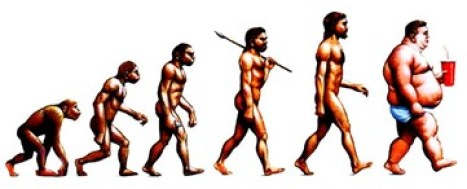
This image treats the standard icon of human evolution with the contempt that it deserves while witnessing in a humorous way to the undeniable biological reality of “genetic entropy”—in other words, that we are not actually “evolving into superman” but “devolving into Macdonald’s man”! This is a great way to smash the sacrilegious icon of man’s alleged evolution from the apes, and it should be linked to the restoration and widespread propagation of the traditional holy icon of the creation of St. Adam, as it has been and continues to be written by Catholic iconographers all over the world since the first millennium.
But there is one more thing that faithful Catholics can do to help defend and restore the true faith and worship of the Church through Holy Iconography. And that is to pray and work for the creation of a new icon of St. Adam and St. Eve that will show the exalted dignity of our first parents as they came forth from God in the beginning. The first iconoclastic persecution continued for more than a hundred years before it was finally brought to an end, so the widespread acceptance of the icon of human evolution within Catholic academia for a similar period of time ought not to discourage us. In our books, videos and newsletters, we have often referred to the testimony of the sacred liturgy and of the approved mystical saints of the Church to the spiritual, moral, intellectual and physical perfection of our first parents before the Original Sin. We have also pointed out that a clear understanding of this “original perfection” of our first parents constitutes the necessary foundation for the healing arts, since only a clear knowledge of the nature of that first perfection gives medical practitioners, psychologists, and their associates an objective ideal of what constitutes normal, healthy, human life. And, without a clear knowledge of that ideal, which all evolution-believing doctors and scientists lack, it is impossible to heal spiritual, mental, emotional or physical illness, because the healer does not know what constitutes the health that he is trying to restore in his patients.
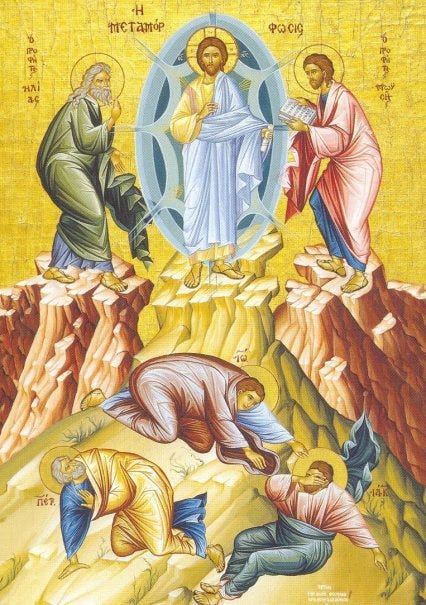
Our Fathers in the Faith handed down to us the traditional icon of the creation of St. Adam shown below. It powerfully refutes the diabolical myth of human evolution from lower life-forms by making present the reality that the “first Adam” was immediately created body and soul in the perfect image and likeness of the “last Adam,” Our Lord Jesus Christ. However, no doubt because of the widespread influence of Gnosticism and Neo-Platonism in the patristic era, the founders of the iconographic tradition were not inspired to show St. Adam in the glory that he actually possessed, radiating the light of God as Our Lord Jesus Christ Himself did on Mt. Tabor at His Holy Transfiguration. In an atmosphere permeated with the ideas of Gnostics and Neo-Platonists who denigrated the material creation and even the human body, a portrayal of St. Adam in his state of Original Holiness might have misled the faithful into thinking that St. Adam and St. Eve were not fully human creatures, possessed of a human body and soul, living one life with God in their humanity.
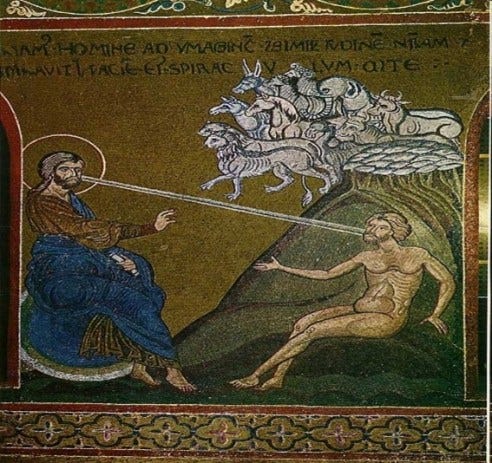
Today, however, I believe that the time has come to “sing unto the Lord a new song,” and to pray that Our Lord and the Holy Theotokos will inspire an iconographer to write a new icon that will show forth the spiritual and physical perfection of our first parents before the Fall and give the lie to the diabolical deception of human evolution and to the myth of humanity’s progress from a “primitive” ancestry to an AI-generated, evolution-based, trans-human Utopia at some future Omega-point. Is this not exactly the kind of thing that Our Lord had in mind when He said, “Every scribe instructed in the kingdom of heaven, is like to a man that is a householder, who bringeth forth out of his treasure new things and old”? (Matthew 13:52) In his nearly-finished, animated video “Adam’s Nightmare,” graphic artist Wally Faucheux is making an important contribution to this effort to replace the false and blasphemous icons of human evolution with authentic Catholic iconography. But I believe that there is still a great need for a gifted Catholic iconographer to write an icon of St. Adam and St. Eve that bears witness to the full splendor of man’s original creation, that refutes the blasphemous icon of human evolution, and that reminds all who see it of the truth of the words of St. Irenaeus, “The glory of God is a man fully alive”!
Through the prayers of the Mother of God, may the Holy Ghost guide us into all the Truth!
Yours in Christ through the Holy Theotokos, in union with St. Joseph,
Hugh Owen
Really interesting article. Have you heard of the Panagia Portaitissa icon and its own history with iconoclasm? It's a beautiful one.