

Metamorphosis
Kolbe Report 6/10/26

Dear Friends of the Kolbe Center,
Glory to Jesus Christ!
In previous newsletters we have highlighted the way that microbe-to-man evolution did not gain widespread acceptance until industrialization and urbanization had cut off most of Christendom from the land. We have argued that this was necessary because people who live in continual contact with nature and who work the land would never have accepted, for example, the outrageous claim that insects evolved millions of years before birds. Millennia of experience confirm the commonsense intuition of farmers across the globe that a year without birds would be sufficient to let insects devastate vegetation and plunge the world into famine and that God knew what He was doing when He created birds and insects together during the Hexameron.
Another way that insects defy evolutionary mythology is through the process of metamorphosis. Almost nine out of ten insects undergo this amazing transformation from one kind of body plan to another, a process that utterly defies any kind of evolutionary explanation. In the photographs below, we see the metamorphosis of the Monarch Butterfly which begins its life as a caterpillar larva, feeding on milkweed plant leaves. The larva hatches from the egg and remains in this stage for about two weeks. In the second stage of metamorphosis, the caterpillars attach themselves head down to a twig, shed their outer skin and make a cocoon, to transform into a pupa (chrysalis). Then most of the caterpillar tissues dissolve and are re-formed into a butterfly—under its genetic program—so that at first it looks like a waxy jade vase.
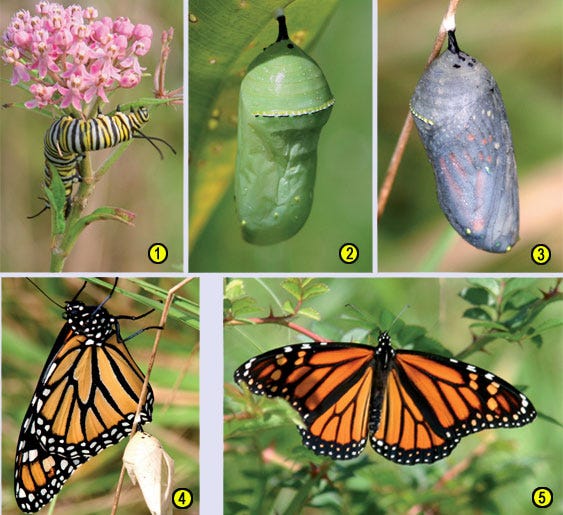
As the metamorphosis progresses, the chrysalis becomes increasingly transparent, so the colors of the butterfly can be seen. After 9–15 days, the Monarch Butterfly finally emerges and inflates its wings by pumping blood from a pool of blood it has stored in its abdomen into the wing veins.

In evolutionary mythology, the environment stimulates organisms to adapt and favors genetic mutations that allow it to adapt to changes in the local environment. But how could a caterpillar possibly benefit from dissolving itself into mush? What series of random mutations could possibly transform the body plan of a caterpillar with three pairs of true jointed legs on the thorax, five pairs of false legs on the abdomen, and six pairs of simple eyes into the body plan of a butterfly with six legs , four wings (two hindwings and two forewings), and large compound eyes made of thousands of ommatidia and sensory antennae covered in scales for smelling molecules? Common sense suffices to conclude that one kind of complex body plan can only be transformed into a radically different complex body plan if the immaterial soul of the creature is programmed to direct that transformation. The fact that nine of out of ten insects undergo this kind of amazing transfiguration underscores the utter absurdity of an evolutionary origin of metamorphosis.
“He Was Transfigured Before Them”
Perhaps the only thing in the world that is more remarkable than insect metamorphosis is the transformation of an unbaptized human being into a saint, a process which the New Testament describes using the Greek word from which we derive our English word “metamorphosis.” Moreover, the New Testament makes clear that the transformation of a sinful human being into a saint is not an evolutionary process but a restoration of human nature back to the way that God created it in the beginning.
It is ironic that the Church’s teaching on this important topic was so obscured by the spread of evolution-based modernism in Catholic academia at the beginning of the twentieth century that geniuses fell into truly embarrassing and diabolical errors. Fr. Alfred Loisy was typical of brilliant Catholic intellectuals who reflected on Our Lord’s promise to the Apostles that some of them would “see the Kingdom of God coming with power” before they died. Having lost their faith in the First Perfection of the Universe and the reliability of the patristic consensus, Fr. Loisy and his modernist peers concluded that “the Kingdom of God coming with power” must refer to the establishment of an earthly kingdom in Israel. Thus, they concluded that Our Lord was mistaken in His prediction and that the establishment of the Catholic Church with her hierarchical structure and her sacraments was the Apostles’ response to Our Lord’s failure to make good on His prediction!
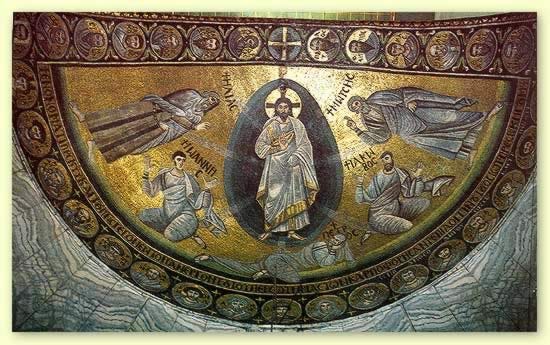
If Fr. Loisy et al had maintained respect for the patristic tradition, they would have realized with the Church Fathers that the fulfillment of Our Lord’s promise actually took place in the next two verses after the promise was made! In the words of St. Matthew:
And after six days Jesus taketh unto him Peter and James, and John his brother, and bringeth them up into a high mountain apart: And He was transfigured before them. And His face did shine as the sun: and His garments became white as snow (Matthew 17:1-2).
Thus, “the Kingdom of God coming with power” denoted the manifestation of the Divinity of Christ reigning in His Humanity, in the same way that His Divinity reigned in the humanity of St. Adam from the moment of his creation until the Fall. According to the principle of “Lex Orandi, Lex Credendi,” in the Byzantine Vespers for the Feast of the Holy Transfiguration the faithful pray:
Through Your transfiguration, You returned Adam’s nature to its original splendor, restoring its very elements to the glory and brilliance of Your Divinity. Wherefore we cry out to You, the Creator of All, “Glory be to You.”
Thus, the first use of the word metamorpho in the New Testament refers to the full manifestation of Christ’s Divinity in His Humanity. But the other two uses of the word do not refer to Christ. They refer to ordinary believers—like you and me.
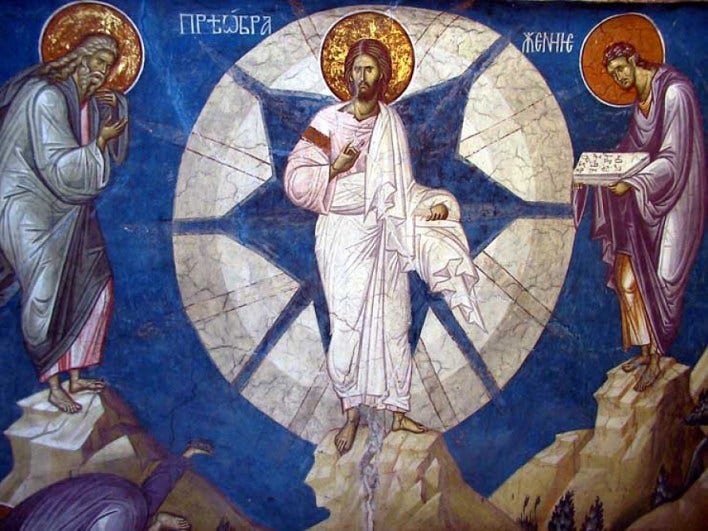
The Greek word metamorphtesmai used in the Greek text is the very word from which we derive our word “metamorphosis,” thus indicating that St. Adam’s human nature was transformed into a sharer in the divine nature in the first created world before the Original Sin and that we can now once again become sharers in the divine nature through the life, death and resurrection of Christ by the work of the Holy Spirit.
“Be Transformed by the Renewal of your Mind”
In St. Paul’s Letter to the Romans, Chapter 11, St. Paul predicts the ultimate conversion of “all Israel” when the “fullness” of the Gentiles enter in to the Kingdom of God. This “fullness” can be interpreted in at least three different ways—as the total number of Gentiles who will be saved; as a representative number of Gentiles from every nation on earth; and as a remnant perfected by the Holy Spirit in whom the fullness of divinity dwells bodily as it did in Christ’s Humanity. It is this last interpretation that makes the most sense in relation to the verses that follow—because St. Paul begins his next section, Chapter 12, verses 1-2, by saying to his Gentile audience:
I appeal to you, therefore, brethren, by the mercies of God, to present your bodies as a living sacrifice, holy and acceptable to God, which is your spiritual worship. Be transformed (metamorpho) by the renewal of your mind that you may prove what is the will of God, what is good and acceptable and perfect (Romans 12:1-2).
Here the Holy Spirit, in and through St. Paul, applies the same word for the revelation of the Divinity of Christ in His Humanity to the manifestation of the Divinity of Christ in the humanity of His disciples. And lest this should scandalize anyone, St. Paul uses the word a second time, in the same sense—as if to remove all doubt about its meaning—in his second letter to the Corinthians. He writes:
We beholding the Lord are being changed (metamorpho) from one degree of glory into another, into His perfect image and likeness. This is the work of the Lord who is the Spirit (2 Corinthians 3:16-18).
In this passage St. Paul once again affirms that every Christian is called to be transformed into the perfect image and likeness of Christ, from one degree of holiness to another, by the power of the Holy Spirit. The Church Fathers clearly understood the similarity between the transformation to which all Christians are called and the transformation that takes place on the altar during the Holy Sacrifice of the Mass. According to St. John Chrysostom:
It is not man that causes the things offered to become the Body and Blood of Christ, but He who was crucified for us, Christ Himself. The priest, in the role of Christ, pronounces these words, but their power and grace are God’s. This is my body, he says. This word transforms the things offered (emphasis added) (quoted in CCC, 1375).
And St. Ambrose wrote of this transformation:
Be convinced that this is not what nature has formed, but what the blessing has consecrated. The power of the blessing prevails over that of nature, because by the blessing nature itself is changed . . . (quoted in CCC, 1375).
St. Paul’s teaching underscores the importance of meditating on the life of Our Lord Jesus Christ, most especially on the interior life of His Most Sacred Heart, so that we can cooperate with the Holy Spirit as He transforms us into Our Lord’s perfect interior image and likeness.
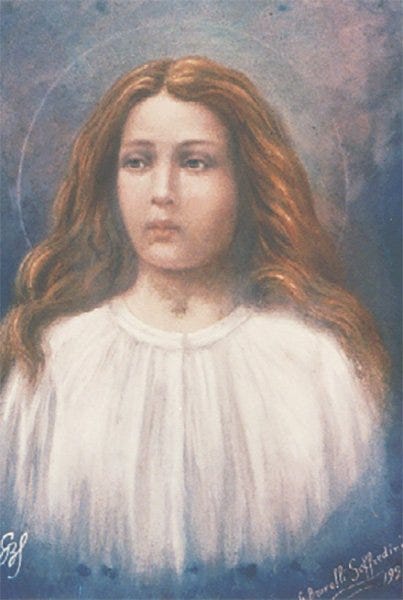
Alessandro Serenelli and Transformation in Christ
We are rapidly approaching the feast of St. Maria Goretti, who obtained the grace of repentance and conversion for her murderer, her cousin Alessandro Serenelli. As the following account demonstrates, the transformation of Alessandro from a depraved and heartless murderer into a saintly penitent is even more wonderful than the transformation of a caterpillar into a Monarch Butterfly!
Alessandro Serenelli was born into a family well acquainted with poverty and hardship. Shortly after he was born, his own mother attempted to drown him. Several months later, while in a mental asylum, she herself died. His brother would also be subsequently interned in an asylum, where he also died.
Alessandro’s father, Giovanni, was an alcoholic who struggled to provide for his children. He moved the family multiple times trying to earn a living as a manual laborer. Unfortunately, his alcoholism prevented his holding down a job for very long. It was while endeavoring as a sharecropper that he met Luigi Goretti, father of Maria Goretti. Both families living in poverty, it was decided that they would partner together and attempt to work as a team for those hiring sharecroppers.
Both men eventually decided to move their families to a small town called Le Ferriere di Conca, near Nettuno, about 40 miles south of Rome. By this time, Giovanni Serenelli had only his son Alessandro living with him. Count Mazzoleni, a wealthy nobleman who owned much land around Le Ferriere, agreed to hire them as sharecroppers. He provided a building that would house the Gorettis on one side and the Serenellis on the other, the two living quarters being separated by a common kitchen.
Within two years, when Alessandro was 18-years-old, Maria’s father died of malaria. His own father being increasingly gripped by alcoholism, Alessandro became more and more reclusive and withdrawn. Most alarming, however, was what he was cultivating in his heart: lust towards Maria. At first Alessandro would make lewd jokes and gestures towards Maria. These were eventually followed by repeated attempts to seduce her. Maria wanted nothing to do with Alessandro and rejected one of his immoral propositions. Knowing he was capable of violence, she was careful never to be alone with him. But Alessandro eventually devised a plan to force Maria into submission: he would approach the house in the middle of the day–when Maria would be alone and everyone else would be at work in the fields–and rape her.
When Maria found herself trapped in the house alone with Alessandro, seeing that his intention was to violate her, she resisted him with all her strength. In fact, her resistance was so great that he was physically unable to rape her. In a fit of rage, Alessandro struck Maria repeatedly with a metal file, delivering 14 puncture wounds. These would kill Maria 24 hours later.
Alessandro was sentenced to 30 years in prison. At his trial, he blamed Maria for her own death claiming that he was defending himself from a sexual attack that she herself instigated. In prison he was locked in isolation as his anger would lead to outbursts of physical violence against other inmates.
One night, six years into his prison sentence, Maria appeared to Alessandro. She appeared in a garden picking 14 white lily flowers, handing them to him one by one. This gesture of forgiveness, this act of love, filled Alessandro with light and the Holy Spirit. He immediately became contrite for what he did to that little girl. He finished the rest of his sentence in tranquility. In fact, his behavior became so docile, and the transformation of his person was so dramatic, that he was released three years early. Shortly after his release he sought out, and received, the forgiveness of Maria’s mother. He eventually joined the Capuchin Franciscans and, as a lay brother, worked as a gardener, porter, and general laborer. He died in the peace of Christ, with the love and admiration of those that knew him, at the Capuchin convent at Macerata, Italy, on May 6, 1970.
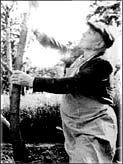
Following his death, the Capuchin friars with whom he lived found a sealed envelope among his personal effects. It was his spiritual testament, written in the form of an open letter to the world. It contains an appeal that all follow the way of Christ. It also paints a dramatic and touching picture of a man who was able to regain his dignity through the generous mercy that those he wounded extended to him:
I am now almost 80 years old. I am close to the end of my days. Looking back at my past, I recognize that in my early youth I followed a false road—an evil path that led to my ruin. Through the content of printed magazines, immoral shows, and bad examples in the media, I saw the majority of the young people of my day following evil without even thinking twice. Unworried, I did the same thing. There were faithful and practicing Christian believers around me, but I paid no attention to them. I was blinded by a brute impulse that pushed me down the wrong way of living.
At the age of 20, I committed a crime of passion, the memory of which still horrifies me today. Maria Goretti, now a saint, was my good angel whom God placed in my path to save me. Her words both of rebuke and forgiveness are still imprinted in my heart. She prayed for me, interceding for her killer. Thirty years in prison followed. If I had not been a minor in Italian law I would have been sentenced to life in prison. Nevertheless, I accepted the sentence I received as something I deserved.
Resigned, I atoned for my sin. Little Maria was truly my light, my protectress. With her help, I served those 27 years in prison well. When society accepted me back among its members, I tried to live honestly. With angelic charity, the sons of St. Francis, the minor Capuchins of the Marches, welcomed me among them not as a servant, but as a brother. I have lived with them for 24 years. Now I look serenely to the time in which I will be admitted to the vision of God, to embrace my dear ones once again, and to be close to my guardian angel, Maria Goretti, and her dear mother, Assunta.
May all who read this letter of mine desire to follow the blessed teaching of avoiding evil and following the good. May all believe with the faith of little children that religion with its precepts is not something one can do without. Rather, it is true comfort, and the only sure way in all of life’s circumstances—even in the most painful.
Peace and all good.
Alessandro Serenelli
Macerata, Italy
5 May 1961
Through the prayers of the Holy Theotokos, may the Holy Ghost transform each and every one of us into that perfect image and likeness of Christ that He created us to be from the beginning!
In Domino,
Hugh Owen
P.S. June is the month dedicated to the Sacred Heart, but the demonic forces have tried to divert attention from the infinite love of Our Lord's Sacred Heart to the false and perverted affections of men and women who have rebelled against God and His natural law. The Kolbe Center's beloved webmaster Keith Jones and his family run an amazing apostolate that produces and distributes Catholic flags and banners. Please visit their website at this link and prayerfully consider purchasing and flying a Sacred Heart flag or banner this month.